Tenerife travel guide
Best Natural Pools in Tenerife: How to Visit Safely
Discover Tenerife's volcanic natural pools around Garachico and the north coast, with guidance on sea conditions, safety and fitting them into a road trip.
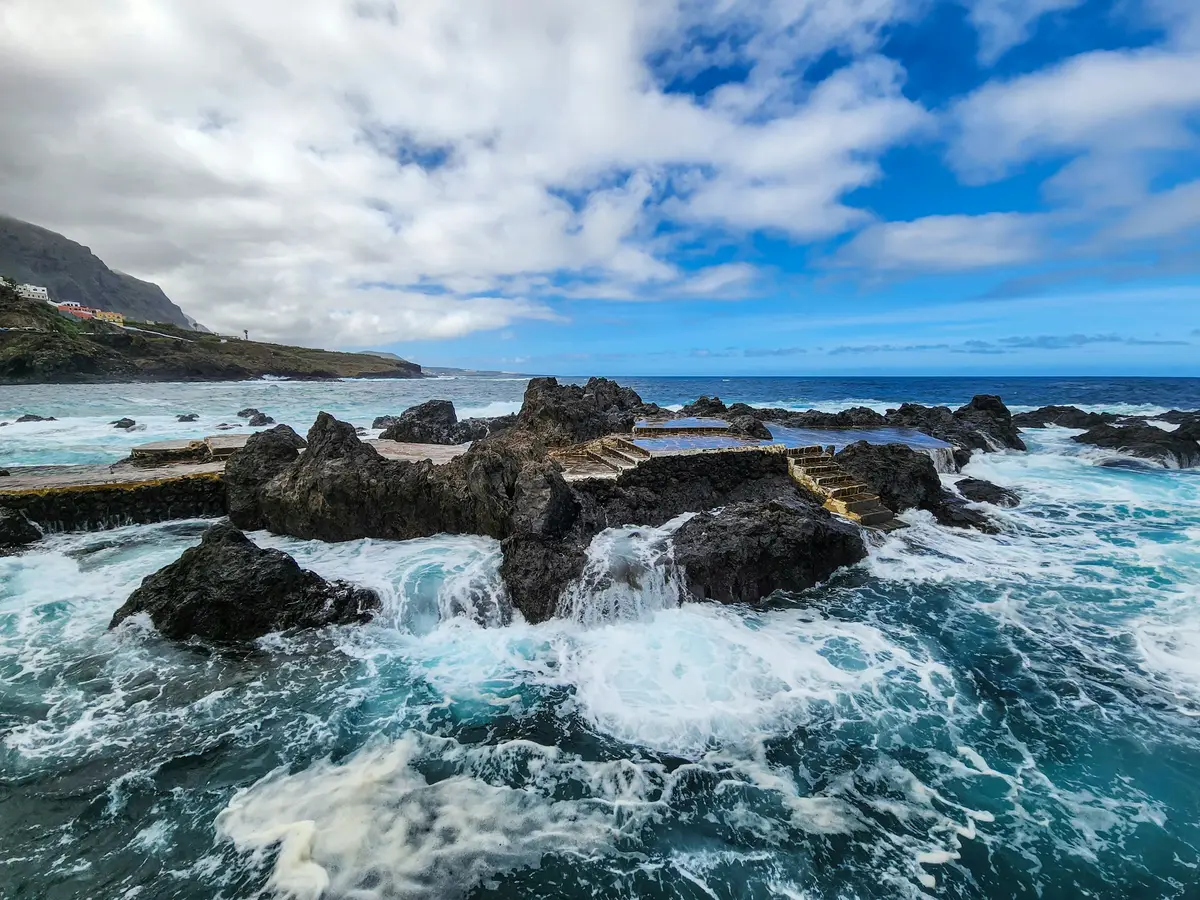
Tenerife's natural pools — often called charcos — are one of the best ways to experience the island's volcanic coastline.
They range from developed bathing areas with steps and facilities to small rock pools exposed directly to Atlantic swell.
The most important rule is simple: a natural pool is not automatically safe because it looks sheltered.
Sea conditions decide whether you should enter.
Why Tenerife has natural pools
Volcanic lava meeting the Atlantic created an irregular coast of:
- rock shelves;
- channels;
- basins;
- coves.
Some have been adapted with ladders, walkways and changing areas.
Others remain much closer to wild swimming.
This makes the north and north-west coast particularly interesting for visitors who want something different from a standard resort beach.
El Caletón in Garachico
Garachico has Tenerife's best-known natural bathing complex.
El Caletón sits beside the historic town and is closely connected to the volcanic landscape created around Garachico.
It is easy to combine with:
- old-town walk;
- lunch;
- Icod;
- a north-west road day.
Even at a developed pool, obey local closure signs when the sea is rough.
North-coast pools
The north coast contains many charcos and seawater bathing areas.
Examples are found around municipalities such as:
- La Guancha;
- San Juan de la Rambla;
- Tacoronte;
- Los Silos.
Do not turn this into a checklist of remote pools.
Choose one that fits the day's route and current sea conditions.
A beautiful pool that requires a long detour is not automatically better than a safe one beside a town you already want to visit.
Puerto de la Cruz
Puerto de la Cruz has developed seawater bathing options and volcanic coastal areas nearby.
If you stay in Puerto de la Cruz, a north-coast pool can be an easy half-day addition.
This is one of the advantages of a northern base: you can react to local conditions without crossing the island.
South Tenerife
The south has fewer of the classic north-coast charco experiences, but there are rocky bathing areas and coves.
La Caleta, for example, has a volcanic shoreline and swimming areas rather than a broad resort beach.
If you are staying in Costa Adeje, that can give you a coastal change without driving to Garachico.
Natural pool vs beach
Choose a natural pool for:
- volcanic scenery;
- rocky coast;
- local swimming atmosphere;
- a stop on a road trip.
Choose a developed beach for:
- predictable facilities;
- easier family logistics;
- sand;
- lifeguard coverage where provided.
The two experiences complement each other.
See best beaches in Tenerife for the broader comparison.
Sea safety
This is the most important part of the guide.
Atlantic swell can:
- wash over walls;
- create surge inside a pool;
- make ladders unusable;
- knock swimmers against rock;
- turn an easy entry into a difficult exit.
Never enter because other people are already swimming.
Check:
- flags;
- municipal closures;
- local signs;
- wave conditions.
If waves are breaking strongly over the outer wall or rock shelf, stay out.
Tide
Some pools change significantly with tide.
A pool that is calm at one state of tide can become more exposed later.
Visitors unfamiliar with Atlantic conditions should favour developed, monitored bathing areas rather than remote wild pools.
Children
Families should choose the most developed pools with:
- easy entry;
- clear boundaries;
- facilities;
- local safety information.
A shallow-looking rock pool can still receive sudden wave energy.
Keep children away from exposed ocean edges even when they are not swimming.
Footwear
Rocky areas can be:
- sharp;
- slippery;
- hot in sun.
Water shoes or secure footwear may help depending on the site.
Flip-flops can be poor choices on wet volcanic rock.
Facilities
Facilities vary enormously.
One pool may have:
- showers;
- toilets;
- ladders;
- cafés.
Another may have nothing.
Check before travelling if your group needs:
- toilets;
- changing;
- shade;
- accessible entry.
Do not assume “natural pool” describes a standardized attraction.
Parking
Small coastal locations can have limited parking.
Do not block residents or leave a rental car in an unsafe roadside space.
Arrive earlier at popular pools, especially on warm weekends.
For a multi-stop day, choose a pool where parking fits the route.
Natural pools and road trips
The strongest way to use natural pools is inside a north-west day.
For example:
- Icod;
- Garachico;
- El Caletón if conditions are safe;
- coast or dinner.
Another option is a north-coast drive where the pool is the main swimming stop rather than the only purpose of the day.
See Tenerife road trip.
Winter
Natural pools remain attractive in winter, but Atlantic swell can be more important than air temperature.
Do not force a swim because the south-coast hotel was warm that morning.
A winter north-coast day can still be excellent for scenery and towns even if the sea is unsuitable.
Snorkelling
Some rocky bathing areas can have clear water and marine life.
Only snorkel when:
- conditions are calm;
- entry/exit is safe;
- you understand the site.
For a dedicated marine experience, use our snorkelling in Tenerife guide instead of assuming every charco is a good snorkel location.
Are natural pools worth a special day?
Usually no.
They are strongest as part of a north or west road trip.
If volcanic swimming is a major interest, choose one or two carefully.
For most first-time visitors, Garachico is the easiest place to combine a memorable natural pool with a destination that is worth visiting even if the water is closed.
Use Garachico and Tenerife weather to plan the day.
Keep planning
Build the rest of your Tenerife trip
Use the core planning guides to connect where you stay, what you do and the day trips that are worth the travel time.